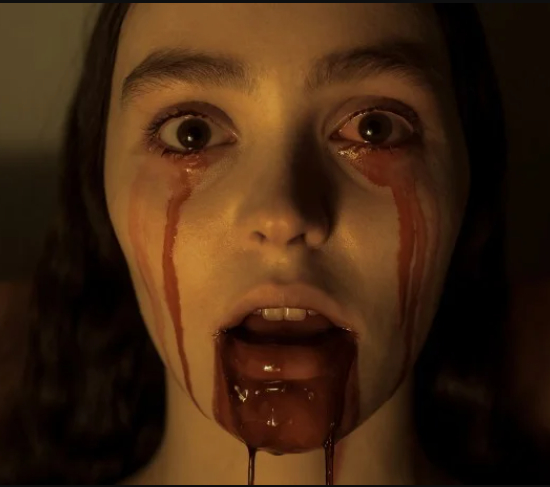
Going into Robert Eggers’ latest work, NOSFERATU, I was eagerly expecting Eggers’ most explicity violent and sexually charged film. Having now watched it fully, I have to look back as his previous works as such. Which is to say, Director/Screenplay writer Eggers’ retelling of the 1922 silent, german-expressionist film of the same name, itself an unauthorized adaptation of Bram Stokers Dracula, creeps as close to mainstream sensibilities as any of his films thus far. With an alluring cast of horror veterans including Willem Dafoe and Bill Skarsgard, foregrounding a star-making and skin-crawling performance by newcomer Lily-Rose Depp, the casting itself will surely serve as seduction upon the masses. Even the act of remaking what is likely one of horror’s most well known and popular IPs, Eggers intentionally seeks to enthrall a wider audience than ever before. Which isn’t a nefarious thing. Eggers’ oeuvre thus far has been original works that delve into horror archetypes, with a mind more towards subtext and a post-modern psychoanalysis of characters who exist in the past, themselves tragically lacking such information and perspective. Eggers is keenly aware of this, and so too does Nosferatu, in this retelling, become more than just a monster movie, but vehicle of warning to us in A.D. 2025, while delivered primarily as a gothic story of a survivor of sexual assualt. Eggers trusts his audience to pick up on this, and even one of my Twitter (I refuse to call it X) follows @Hoodanakarta mentioned in a post that “The movie is about a woman being forced to confront her abuser because all of the men in her life are too fucking stupid to be of any help whatsoever or actually effectively protect her from him.” Indeed, it is Ellen, (Mina Harker is Stoker’s version) who must endure the blessing/curse of spiritual “conductivity” that initially draws the beast to her, as well as the resultant horror of her reccurring, trauma induced night-terrors. From this perspective, Nosferatu has an important message to inculcate in modern audiences that rings sadly ever truer with accumulating headlines of men in celebrity abusing their power: believe survivors and pursue abusers. Even if they are made seemingly untouchable by wealth or position, lest their plague of violence decay the very social order, before at last, reaching your doorstep.
Teeming, plague-spreading rats among the populace are in fact one of many dark tools of the Nosferatu’s oppression. One of the ways this monster resembles contemporary leaders of today. Contemporary audiences will be familiar with the world-stopping power of COVID-19, a globally experienced plague that may have resulted in record profits & consolidation of power by already ultra-rich corporations. Nosferatu is an outsider, exotic and intriguing, but European enough to understand and even manipulate the bureuacratic machinery of our society to his advantage. Reminds me of another populist ghoul, Elon Musk. Unlike the comparitively genteel and and respectability minded leaders of old like Count Dracula, Count Orlok is more forcefully monstrous, barbaric, nakedly rapacious. Indeed, his characterization in this version is that of a wealthy, but musty, entitled aristocrat, who lacks the self-consciousness to chuckle at the irony in calling the vampire-slaying villagers at the foot of his mountain “filthy.” Reminds me of Donald Trump’s gasbaggerie. Characters throughout the film intimate Orlok’s undead-ness to originate from un-christian black magick; the word “solomanic” is used, referring to “Soloman’s Goetia,” a throng of demons from Hebrew mysticism said to bestow power to those willing to sacrifice salvation. Is Orlok a pre-modern occult sub-reddit trawler? Maybe. The point Eggers is trying to make, I believe, is that we live amongst Orloks today, and that we would do well to inoculate ourselves against their soul-rotting influence by questioning and calling out people in powerful positions. Unlike the humans in the film whose motivations are bandied about by misogyny, pursuit of economic security and good old fashioned societal niceties, we need to remain firm in those values sometimes lost in, as Dafoe’s Eberhart puts it, “the gaseous science of our age.” Plainly it is those simple Roma folk, and nuns in age-old churches clinging to tradition and folk wisdom who seem most prepared to deal with such devilry.
Nosferatu is, as well, dreadfully beautiful to gaze into. An especially haunting sequence occurs when Nicholas Hoult’s Thomas Hutter (Stoker’s Jonathan Harker) reaches a crossroads in a shadowy forest, buffeted by falling snow and blowing wind. The black, horse-drawn carriage approaches, surreally slowed, as if we are experiencing it in a dream-like intoxication. The horses disappear, the carriage instantly opens, and Hutter is levitated inside before being spirited away towards Orlok’s ominous castle abode. Even the sequence inside the castle, where Hutter slices open his thumb, becomes terrifying to behold, as Orlok literally flips us, and him upside down before closing in on his helpless prey. Watching the film, it’s hard believe that the total budget ranges only around 50 million USD. Eggers deserves praise for assembling a phenomenal team of sound, costume and productions designers, as the film is consistently a wonder to behold. Truly an immersive and hypnotic remake of the 1922 film. But there were points during my watch when I had to laugh despite the grimness on screen. The lack of background of some of the main characters and the acting choices of others, at times, left most of the work of “doing horror” to the world around them. Lily-Rose Depp mentioned in an interview that her physicalities, while possessed, were inspired by a form of Japanese theater that emphasizes the grotesque. I suspect she was referring to “Butoh,” a post-WWII performance style of dance that uses playful and distressing imagery. An appropriate motif for Nosferatu’s expressionist origins. I respect her as an actor for making interesting artistic choices, and commend her for her boldness on screen. Maybe it was the script, or just the reliance on spectacle, but I am more excited to see where her acting career leads next. She obviously has taste and talent. I am less impressed by her scenes where she is to portray a more grounded, human performance. She obviously has a flare for the dramatic, much like her father, and will no doubt become a star in her own right. As for the others, they deserve their flowers for all around solid performances. Willem Dafoe does what he does so well–eccentric and entertaining character acting–which by all means I hope he keeps doing forever! Special kudos to Bill Skarsgard who has the onus of portraying Orlok himself. His tonations and growlings and thick accent reverberate through every scene he’s in. Skarsgard delivers a scary, if not nearly as sympathetic, version of the ghastly Nosferatu/Dracula we’ve been exposed to thus far. As actors it must’ve been a task to affect, with the scenery so nearly chewing on them.
The Marketing for this film deserves acclaim, as burgeoning memes, takes, analyses and pop-culture appeal are doubtlessly trailing Orlok’s coat-tails as we squeak. Nosferatu has, even in its early run, become the latest talk of the virtual tonne. I admit I may have gotten too wrapped up in the hype before watching, and may have expected something much hornier and bloodier than what I got. But much like our hapless Hutter, getting far more than he bargained for once within the depths of the Count’s crumbling mausoleum, I have in reviewing, found much less a gore fest than a film whose ambition is to enrapture a wider swathe of bodies. Much more than just the filmicly nerdy among us. In his by now signature psychological take on classic horror, Eggers’ bite should sink more than skin-deep, and will hopefully engender many an audience as they horror and delight in succumbing.


 TABLEMOLD